¶ Liposomal Vitamin C
Liposomal vitamin C is a form of vitamin C that is surrounded by a small sphere of lipids (oils) called a liposome. Vitamin C is a water based vitamin, so the amount that can be absorbed is is limited. Surrounding the vitamin in a liposome can increase the absorption, which is particularity useful when fighting an illness or recovering from exposure to toxins.
The liposome can be thought of as a delivery vehicle for the vitamin C that helps it arrive where it is needed in the body, and stay around longer than ascorbic acid would by itself.
Liposomal C can be purchased from various sources such as LivonLabs, but it is more economical to make it yourself. In this guide, we describe our preferred process, based on a patent by Yuanpeng Zhang. This recipe was developed by [author], but strangely the site was taken down near the beginning of the SARSCOV2 incident. It is only available now from the wayback machine. We have recorded it here because of the importance this recipe has in improving health and wellbeing.
¶ Process Overview
This section outlines the process to create liposomal vitamin C. For details on the equipment needed please refer to the equipment section. The sizing of this recipe is for a standard sized blender and a one litre beaker.
For background on why we prefer this particular process read the research section. This recipe should yield lipsomal vitamin C the same or better than can be purchased online from the large manufacturers.
At each step are outlined the modification to the process if you don’t have an ultrasound machine.
¶ Quick Recipe Guide
1) Measure out 255 g of RO water
2) Warm the water slightly in a pan
3) Measure out 161 g of Vitamin C and add it to the warmed water
4) Measure out 338 g of Vodka
5) Mix until all powder is dissolved
6) Add to blender, and blend for one minute
7) Measure out 197 g of lecithin powder and add to blender
8) Blend for five minutes
9) Refrigerated until cold
10) Repeat blend/chill cycle for up to 24 hr (the longer the better)
¶ Ingredients
There are two versions of the ingredients. The first is for those that have access to 98% pure ethyl alcohol. The second is for those that only have access to vodka, or a similarly strong spirit. It is recommended that the vodka, or other clear spirit has as little added color and taste as possible.
The amount of vitamin C is just under the saturation level for the specified water and alcohol in this recipe. Since It is almost the maximum amount of vitamin C that can be dissolved it will give the highest potency liposomal vitamin C possible.
The 12% alcohol by weight was chosen because it falls within range specified by the patent and is the same used by Livon Labs. The alcohol is included because it is very helpful in forming liposomes.
The lecithin granules are 22% phosphatidylcholine. For my liposomal vitamin C I use the Solec P’ brand from ‘The Solae Company’. Be sure to use lecithin granules instead of liquid lecithin. Soy should not be used because of is high in toxins. Sunflower lecithin is recommended.
¶ Ethyl Alcohol Ingredients
These ingredients should be used if you have access to 98% pure ethyl alcohol. This ethyl alcohol recipe is the one I use for my personal liposomal vitamin C. The following table shows the ingredients and their order of use.
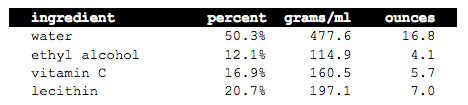
All the ingredients are measured by weight.
¶ Vodka Ingredients
These ingredients should be used if you have access to vodka or other clear 40% spirit instead of ethyl alcohol. The following table shows the ingredients and their order of use.

All the ingredients are measured by weight.
¶ Changing the Recipe Size
Both these recipes have been chosen to fit into a standard sized blender and a 1L beaker. The total weight of the ingredients is 950g and it makes about 800ml liposomal vitamin C after the bubbles have been removed. Before the bubbles have been removed the volume will be closer to 900ml.
You may adjust the recipe to these common sizes by dividing the quantities by the specified amount.

For example, if you want to make 2 cups of liposomal vitamin C after the bubbles have been removed you’d divide all the quantities in your selected recipe by 1.6.
All measurements need to done by weight, especially the vitamin C and lecithin granules. Using tablespoons or teaspoons will not provide the accuracy required because these ingredients may have different densities when purchased from different sources.
If you don’t have a scale you should purchase a cheap kitchen scale (see the Equipment section).
¶ Neutralizing To Sodium Ascorbate
Some advocates of Vitamin C recommend that some of all of your intake be in the ionic form, sodium ascorbate, instead of as ascorbic acid. Especially for young children, this can help make it more palatable, as it is less sour. However, it should also be noted that the acidity can help with preservation.
We recommend neutralizing some of the acid to sodium ascorbate, so that there is about 50% ionic and 50% acidic form present. This can be done with baking soda, but is best done with food grade sodium hydroxide (lye). Note that is absolutely must be food grade, as much of the lye available such as is used as a drain cleaner is not pure enough. You can also purchase sodium ascorbate directly, and use it instead of ascorbic acid in this recipe.
¶ Ingredients & Equipment
Ascorbic acid powder (Vitamin C)
Sodium hydroxide (NaOH) — pure food-grade or lab-grade
Distilled water (not tap water)
Digital kitchen scale (accurate to 0.1 g)
Heat-safe glass jar or beaker
Small whisk or stirring rod
pH test strips (range ~6–10)
Gloves, eye protection
¶ Stoichiometry
Sodium ascorbate forms by neutralizing ascorbic acid with sodium hydroxide:
C6H8O6 (ascorbic acid) + NaOH → C6H7NaO6 (sodium ascorbate) + H2O
Molar masses:
Ascorbic acid = 176.12 g/mol
Sodium hydroxide = 40.00 g/mol
Ratio: For every 1 g ascorbic acid, use 0.227 g NaOH.
Example:
10.0 g ascorbic acid → 2.27 g NaOH
¶ Procedure
Prepare your workspace
Put on gloves & goggles. Work away from pets and kids. Ensure good ventilation.
Dissolve the ascorbic acid
Measure your ascorbic acid (e.g., 10 g).
Place in the glass container.
Add about 50 mL of distilled water. Stir until dissolved.
Prepare NaOH solution
Weigh the correct amount of NaOH (e.g., 2.27 g for 10 g acid).
Slowly add NaOH pellets to ~20 mL distilled water in a separate container, stirring until dissolved.
Always add NaOH to water, not the reverse, to avoid splashing.
Neutralize
Slowly pour the NaOH solution into the ascorbic acid solution while stirring.
Reaction is mild but may warm slightly.
Check pH
Dip a pH strip. The goal is ~pH 7.0–7.5.
If acidic (<7), add very small amounts of NaOH solution.
If basic (>7.5), add a pinch more ascorbic acid.
Final dilution & storage
Dilute to your desired concentration with distilled water.
Store in a clean, sealed glass jar in the fridge if using as a solution.
For dry powder: evaporate water at low temperature (<40 °C) and store airtight.
¶ Safety Notes
NaOH is highly caustic. A single splash can damage skin or eyes.
Avoid inhaling dust from powders.
Neutralize spills with vinegar before cleanup.
This method is suitable for lab-style preparation, not for therapeutic use unless purity and measurements are verified.
¶ Step 1: Dissolve Vitamin C in Water and Alcohol
Measure and add the water, alcohol and vitamin C to the beaker. Place the beaker in the ultrasonic bath and heat to 35°C while irradiating. Be sure the ultrasonic machine is not set to sweep and that you stir the mixture regularly. As a general caution, be sure your beaker isn’t touching the sides or bottom of the ultrasonic bath and that the water in the ultrasonic bath is to the level recommended by the manufacturer.

The vitamin C about to be dissolved in the water and alcohol

Settings for the ultrasound machine
As shown, a cardboard form can be used to keep the beaker from touching the bottom of the ultrasonic tank. Alternatively, a stainless steel basket would work, however, the developer of this recipe found that the ultrasonic power was noticeably less when he used the basket instead of suspending the beaker in the water with the cardboard.
When this process completes the temperature will be close to 40°C and the liquid will be clear with perhaps a very slight yellowish tinge. In the Elmasonic p60h, pictured, it takes about 15 minutes to dissolve the vitamin C with intermittent stirring.
If you don’t have an ultrasonic machine simply place the water, alcohol and vitamin C on the stove and heat while stirring. Be sure to turn off the heat when the vitamin C starts to dissolve. Keep on stirring until the vitamin C has been completely dissolved. You may add a little more heat at intervals if its needed to continue the dissolving process.
¶ Step 2: Add Lecithin and Blend
Add the lecithin to the beaker (if you’re using the cumulative column) and then promptly pour into the blender.

Lecithin granules added to the water, alcohol and dissolved vitamin C

Mixture promptly poured into the blender
Blend for about three minutes and then place in the refrigerator.

First blend completed and ready for the refrigerator
Repeat this blending and refrigerating process five or six times over twelve hours to be sure the lecithin granules have been thoroughly dissolved into the water, alcohol and vitamin C solution. If you are more patient, you can do the blend and refrigerate cycle for 24 hours, which may give better results.
By the end of this process you’ve already created high quality liposomal vitamin C. The following steps show you how to improve it further using an ultrasound machine.
If you don’t have an ultrasound machine you may want to do more blending and refrigeration cycles and then skip to step 5!
¶ Step 3: Remove the Bubbles
The blending process will add tiny bubbles to your liposomal vitamin C. For the ultrasound machine to work at peak efficiency you’re going to want to remove these bubbles.
Blend the mixture a final time until the blender jar feels warm to the touch. The liposomal vitamin C should now be about 35°C. Pour the liposomal vitamin C into the beaker and cover with some clear plastic wrap.
Next place the beaker in the ultrasound machine for about 30 minutes or until the bubbles have been removed. Below are a series of photos showing the bubbles being driven out of the mixture over time by the ultrasound machine. The color has been modified to make it easier to see the bubbles moving upwards. The horizontal line indicates the current bottom of the bubbles.

Bubbles leaving the liposomal vitamin C
When the bubbles have been removed the liposomal vitamin C should look like this. Notice the much more defined line between the bubbles on the top and liquid on the bottom.

Bubbles removed from liposomal vitamin C
Now place the beaker with the liposomal vitamin C in the refrigerator for a few hours to cool it down.
This step may break down some encapsulation due to excess heat, however, it is necessary to remove the bubbles. The encapsulation will be increased significantly in the next step.
If you don’t have an ultrasound machine you should skip this step.
¶ Step 4: Increase the Liposomes
You’ve already made lots of liposomes! This step will increase your encapsulation percentage even higher.
Place your liposomal vitamin C in the beaker into your ultrasound machine and irradiate it until the temperature reaches 32°C. Once it does, place the beaker back into your refrigerator for an hour or so to cool it down again.
Repeat this process until the liposomal vitamin C has had an hour of cumulative ultrasonic irradiation.
If you don’t have an ultrasound machine you should skip this step.
¶ Step 5: Done!
Pour into a glass container and place in your refrigerator. You’re finally ready to enjoy the uniquely refreshing flavour of liposomal vitamin C!
¶ Equipment Overview
This section details the equipment used in the production of liposomal vitamin C.
Even if you don’t have an ultrasound machine you can still make excellent liposomal vitamin C. See the Research section for more detail.
¶ Measuring Device
You’ll need to have a scale to weigh the ingredients. Correct measurement is important for repeatable results. Here is an example of a cheap one:

Cheap Scale
The Ohaus Triple Beam TJ611 with extra weights had increased precision. This type of scale isn’t required to make liposomal vitamin C, however, if also making liposomal antibiotics, the increased precision is helpful.

A Better Scale
Regardless of your choice of scale, make sure to use it!
¶ Blender
You’ll need a blender to help dissolve the lecithin granules in the saturated vitamin C solution. A cheap household blender is sufficient.

A cheap blender
¶ Ultrasonic Bath
The original developer of this recipe used an Elmasonc p60h ultrasonic bath. It has multiple frequencies, modes and an internal heater.

Elmasonic p60h Ultrasonic Bath
It supports long duty cycles and high power. Cheaper sonicators could be used as well.
The good news is that even if you can’t afford a cheap ultrasonic bath you can still make great liposomes! (See the Research section)
¶ Thermometer
If your ultrasound machine doesn’t have a built in thermometer, or you don’t have an ultrasound machine, you’ll need a separate thermometer. Performing the various steps of the Process at the correct temperatures is important.
The critical temperatures you’ll be watching for are between 30°C and 40°C. A thermometer for measuring your temperature if you’re sick should be fine so long as you can immerse the part that does the measurement.
To say again - the correct temperature matters so be sure you have a thermometer that can measure between 30°C and 40°C!
¶ Glassware
Glass beakers should be used with the ultrasound machine. It is important that the beakers are glass because plastic will significantly weaken the ultrasonic energy. If you have a less powerful ultrasound you might consider making the liposomal vitamin C directly in the machine.
WARNING: Be sure that nothing solid rests on the bottom of the ultrasonic bath as you will damage the machine.

A One Litre Beaker
A one litre beaker that fits in the ultrasonic bath and can hold one blenders’ worth of liposomal vitamin C should suffice.
¶ Storage
The liposomal vitamin C ingredients are susceptible to both moisture and light. With the exception of the alcohol, I store all my ingredients in large wide mouth Ball canning jars. In each jar I place a few ‘moisture absorption’ packets to help extract any excess humidity.

Glass Canning Jar with Moisture Absorption Packets
The finished liposomal vitamin C should be stored in the fridge.
¶ Research Overview
Liposomes were first described in 1961 and have since found use in everything from drugs to expensive skin creams. Their properties and associated manufacturing techniques have been extensively studied.
Unfortunately, much of this research is not easy to read for the non-scientist.
Additionally, current research is focussed on binding various other chemicals to liposomes which themselves are created out of hybrid compounds to provide specific pharmaceutical properties.
Thankfully, we’re interested only in creating simple liposomes from readily available non-toxic materials.
The following are the key findings from research into creating the best possible liposomal vitamin C.
¶ Liposomes are Easy to Make
It turns out that lecithin phospholipids really like to make liposomes!
Despite the marketing material created by such companies as LivOn Labs liposomes are actually very easy to make. You don’t need a high pressure injection system, or even an ultrasound machine!
LivOn Labs recently purchased the US patent number 20120171280A1 that is snappily named ‘Method of making liposomes, liposome compositions made by the methods, and methods of using the same’. It describes a method of making better liposomes than LivOn Labs without the need for any specialized equipment!
The inventor, Yuanpeng Zhang, has a long history of working with liposomes and has a number of related patents to his name.
The summary of his invention is that high quality liposomes may be created using only a blender, water, alcohol and vitamin C - and that these liposomes are better than the ones produced by LivOn Labs!
It’s no wonder that LivOn Labs purchased this patent!
This is fantastic news for all those people that need liposomal vitamin C but don’t have the resources to purchase expensive equipment or liposomal vitamin C directly from LivOn Labs.
A legal disclaimer:
My understanding is that if you’re in the United States (where this patent is valid) then you shouldn’t attempt to use the method described in this patent without approval from Livon Labs.
It is typically impossible for the home manufacturer to validate that they have created liposomes. However, I’m fortunate that I have access to a biological research lab and have used their microscopes to confirm liposome creation. The following is a picture of the liposomes that have been created using the Process described on this website. The picture is a little odd looking because the attached camera was broken and I had to use a standard ‘point-and-shoot’ camera.

Liposomes we’ve created under a microscope
¶ Alcohol is Important
The majority of the liposomal vitamin C community is not aware that alcohol is very helpful in the creation of liposomes.
It is well established that organic solvents help phospholipids form liposomes. While there are many dangerous organic solvents, the one we’re interested in is ethyl alcohol. This is the same type of alcohol that is in your beer, wine and vodka. Its safety has been established over many years and includes long term testing by the author of this website!
LivOn Labs is the current market leader in liposomal vitamin C. Their recipe includes 12% alcohol by weight as a ‘natural preservative’, however, it turns out that this alcohol is also key to creating liposomes.
See the patent reference in the previous section for more detail.
¶ Saturation Matters
Every recipe I’ve read on the Internet calls for dissolving a relatively small amount of vitamin C in water.
For example, the original ‘Brooks Bradley’ recipe calls for dissolving 1 level tablespoon (about 6 grams) of vitamin C in a total of 1.5 cups of water. However, vitamin C solubility is 330 g/L which means that 124 grams of vitamin C will dissolve into that same 1.5 cups of water.
By way of illustration, here is what the difference looks like. On the left is one level tablespoon of vitamin C (6 grams) and on the right is the total amount of vitamin C that will dissolve into that same 1.5 cups of water. There is twenty times more vitamin C on the right!

One tablespoon of vitamin C versus saturation levels of vitamin C
Since liposomes will encapsulate anything that is dissolved in water, you can make your liposomal vitamin C twenty times stronger without any other adjustments to your recipe. Wow!
¶ Lecithin Granule Amounts
Most Internet recipes call for a relatively small amount of lecithin.
It is important that you use lecithin granules as they have very little soy protein and are higher in the components that actually make liposomes such as phosphatidylcholine.
Where I live it is difficult to source high phosphatidylcholine (PC) lecithin. My current source is 20kg boxes of Solec P from the Solae Company (a subsidiary of Du Pont). It has a 22% phosphatidylcholine content and seems to work well in my recipe.
Generally you’ll want to use as many lecithin granules as possible as this provides the highest possible encapsulation of the vitamin C.
The limiting factor is that the resulting mixture needs to be liquid enough at around 32°C that the ultrasound machine is able to drive out the bubbles that are created by the blending process. Bubbles in the liquid absorb ultrasonic energy and significantly reduce the amount of ultrasonic energy that goes into making liposomes.
¶ Dissolving Lecithin Granules
The lecithin granules take time in order to dissolve completely. Most Internet recipes call for soaking the lecithin granules in water overnight.
This idea is correct, however, by soaking in water you end up lowering the amount of vitamin C that will be encapsulated.
I recommend making the saturated solution of vitamin C, water and alcohol (as described in the Process section) and then dissolve the lecithin granules in this. Doing so will maximize the amount of vitamin C that will be encapsulated.
I do the dissolving in a blender so that I can blend it five or six times over the course of 12 hours. Even if you don’t have an ultrasound machine this will significantly encapsulate the vitamin C as described in patent US 20120171280A1 that was purchased by Livon Labs.
¶ Ultrasonic Irradiation
In my experimentation the optimal temperature for creating liposomes is less than 32°C. When you get above 35°C the liposomes start breaking down and lower your encapsulation percentage.
In my recipe I ultrasound above 32°C for the first round in order to drive out bubbles in the liquid. Removing these bubbled improves the ultrasonic energy that is used to create liposomes. After this first round I ultrasound below 32°C to optimize liposome creation.
According to my research a total irradiation time of around an hour is optimal, however, at least ten minutes after you’ve driven out the bubbles should be sufficient depending on the power of your ultrasound machine.
¶ PubMed References
¶ Vitamin C and Illness
- Vitamin C for preventing and treating pneumonia
- Role of vitamins D, E and C in immunity and inflammation
- Mycobacterium tuberculosis is extraordinarily sensitive to killing by a vitamin C-induced Fenton reaction
¶ Vitamin C and the Heart
- Cardiotoxicity and apoptotic activity in subacute endosulfan toxicity and the protective effect of vitamin C in rabbits: a pathological study
- Plasma vitamin C, but not vitamin e, is associated with reduced risk of heart failure in older men
- Effect of vitamin supplementation on serum oxidized low-density lipoprotein levels in male subjects with cardiovascular disease risk factors
- Plasma vitamin C predicts incident heart failure in men and women in European Prospective Investigation into Cancer and Nutrition-Norfolk prospective study
¶ Vitamin C and Diabetes
- Vitamin C intake reduces the cytotoxicity associated with hyperglycemia in prediabetes and type 2 diabetes
- Vitamin C further improves the protective effect of GLP-1 on the ischemia-reperfusion-like effect induced by hyperglycemia post-hypoglycemia in type 1 diabetes
- A short-term evaluation of the relationship between plasma ascorbic acid levels and periodontal disease in systemically healthy and type 2 diabetes mellitus subjects
- Consumption of Mixed Fruit-Juice Drink and Vitamin C Reduces Postprandial Stress Induced By A High Fat Meal In Healthy Overweight Subjects
¶ Vitamin C and Burns
- Reduced fluid volume requirement for resuscitation of third-degree burns with high-dose vitamin C
- The effects of high-dose vitamin C therapy on postburn lipid peroxidation
- High-dose vitamin C therapy for extensive deep dermal burns
- Towards evidence based emergency medicine: Best BETs from the Manchester Royal Infirmary. BET 3: Vitamin C in severe burns
¶ Vitamin C and Surgical Recovery
- Randomized, prospective trial of antioxidant supplementation in critically ill surgical patients
- A Randomized Controlled Trial to Prevent Postoperative Atrial Fibrillation by Antioxidant Reinforcement
¶ Vitamin C and Pregnancy
- Nutrient supplementation: improving male fertility fourfold
- Nutritional status of women with gestational hypertension compared with normal pregnant women
- The role of vitamin C in prevention of preterm premature rupture of membranes
¶ Vitamin C and Neurological
- Reduced Risk of Alzheimer Disease in Users of Antioxidant Vitamin Supplements
- Vitamin C restores behavioral deficits and amyloid-β oligomerization without affecting plaque formation in a mouse model of Alzheimer's disease
- Suppression of Amyloid β A11 Antibody Immunoreactivity by Vitamin C POSSIBLE ROLE OF HEPARAN SULFATE OLIGOSACCHARIDES DERIVED FROM GLYPICAN-1 BY ASCORBATE-INDUCED, NITRIC OXIDE (NO)-CATALYZED DEGRADATION
¶ Vitamin C and Smoking
- Vitamin C forestalls cigarette smoke induced NF-κB activation in alveolar epithelial cells
- Molecular mechanisms of cigarette smoke-induced proliferation of lung cells and prevention by vitamin C
- Cellular and molecular mechanisms of cigarette smoke-induced lung damage and prevention by vitamin C
- Vitamin C reversed malfunction of peripheral blood-derived mononuclear cells in smokers through antioxidant properties
- Oral vitamin C ameliorates smoking-induced arterial wall stiffness in healthy volunteers
- Dietary vitamin C intake is inversely related to cough and wheeze in young smokers